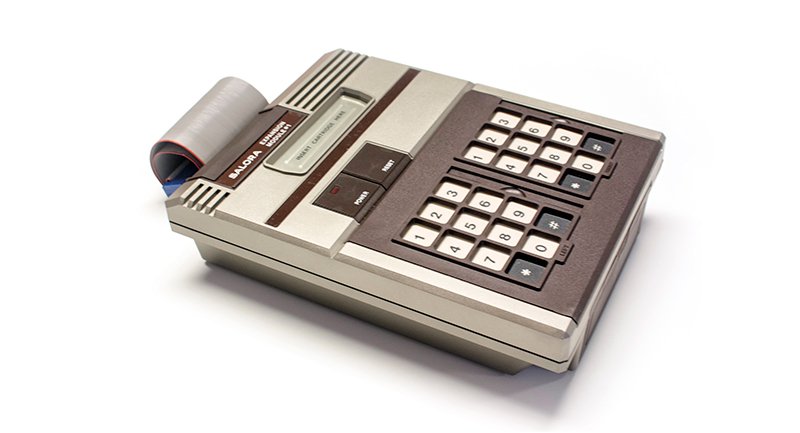
ColecoVision™ Game Module for VTech Laser 2001 & Salora Manager Computers
SYSTEM OVERVIEW
The ColecoVision Game Module for the Salora Manager and VTech Laser 2001 is widely considered the “Holy Grail” of both ColecoVision and CreatiVision collecting. This ultra-rare expansion module converts the 6502-based Salora Manager or Laser 2001 home computer into a fully functional ColecoVision game console, capable of playing standard ColecoVision cartridges.
The module was originally designed by VTech for the CreatiVision Mark 2 — a revised version of their CreatiVision console with hardware modifications specifically intended to support this ColecoVision adapter. Before commercial release, the module was redesigned internally and released exclusively for the Laser 2001 (sold in Europe and Germany) and the Salora Manager (sold in Finland). The CreatiVision Mk2 version was never commercially released.
The module works by adding a Zilog Z80 CPU to the system — the same processor used in the ColecoVision — which takes over from the host computer’s native MOS 6502. It includes its own custom 8 KB BIOS ROM (not the standard ColecoVision BIOS), 2 KB of RAM, its own SN76489 sound chip, a ColecoVision cartridge slot, and two Atari-standard DB-9 joystick ports. The module shares the host computer’s TMS9929 Video Display Processor and 16 KB of VRAM — the only shared hardware component.
In August 2024, the BIOS was finally dumped and publicly shared thanks to Australian collector Mark McDougall and Italian researcher MADrigal, ending decades of mystery surrounding this legendary peripheral.
🏆
The Holy Grail
Considered the ultimate collectible for both ColecoVision and CreatiVision enthusiasts worldwide.
🧬
Z80 on a 6502 System
Adds a Z80 CPU to a 6502-based computer, completely taking over the host processor when active.
💾
Custom BIOS
Contains its own custom 8 KB BIOS — NOT the standard ColecoVision BIOS. Displays “Laser 2001” at boot.
🎮
CV Cartridge Slot
Full ColecoVision cartridge port for playing standard CV game cartridges.
🇫🇮
Finland Connection
Salora Oy of Salo, Finland branded the Laser 2001 as the “Manager” for the Finnish market.
📄
BIOS Dumped 2024
After decades of mystery, the module’s BIOS was dumped and shared publicly in August 2024.
HOW IT WORKS
The ColecoVision module is a fascinating piece of engineering that bridges two completely different CPU architectures. The Salora Manager / Laser 2001 is a 6502-based computer, while the ColecoVision is Z80-based. These processors are fundamentally incompatible — so how does the module work?
What the Module Contains
Zilog Z80 CPU (ColecoVision’s processor)
Custom 8 KB BIOS ROM (modified CV BIOS)
2 KB RAM (double the ColecoVision’s 1 KB)
SN76489 sound chip (duplicate of host’s)
ColecoVision cartridge slot
2× DB-9 joystick ports (Atari-standard)
PCB traces for CreatiVision-style controller ports (unpopulated)
What It Shares with the Host
TMS9929 Video Display Processor (PAL)
16 KB Video RAM
RF modulator for TV output
Power supply (from host computer)
When the module is connected and a ColecoVision cartridge inserted, the Z80 takes control of the system while the host computer’s 6502 CPU is disabled. The Z80 executes the module’s custom ColecoVision BIOS, which initializes the shared VDP and displays ColecoVision games. The module includes its own duplicate SN76489 sound chip because the host computer’s sound chip cannot be electrically connected to the module’s Z80 bus — the audio signal is routed back through the host’s RF modulator. Essentially, the module turns the host computer into a ColecoVision console while borrowing only its display hardware and power supply.
One curious detail: the module contains 2 KB of RAM instead of the ColecoVision’s standard 1 KB. The reason for this doubling remains unclear. It may have been a cost decision (2 KB SRAM chips being readily available), a design margin for future compatibility, or simply the engineers using what was on hand. Regardless, it means the module is technically more capable than a standard ColecoVision in terms of work RAM.
Key Insight: Shared VDP
The reason this module is possible at all is that both the CreatiVision family (6502-based) and the ColecoVision (Z80-based) use the same Texas Instruments TMS9918-family Video Display Processor with 16 KB of VRAM. The VDP doesn’t care which CPU is talking to it — so the module’s Z80 can control the host’s existing video hardware to produce ColecoVision graphics.
CreatiVision Mk2 Requirement
Reverse engineering confirmed that the module was originally designed for the CreatiVision Mark 2, which was specifically revised to support it. The original CreatiVision Mk1 does not have enough signals on its expansion bus to allow the module to function. A homebrew adapter would be needed to make the module work on a Mk2.
Board has unpopulated traces/pads for CreatiVision-style controller connectors, confirming Mk2 origins
HOST COMPUTER SPECIFICATIONS
The ColecoVision module works with the VTech Laser 2001 and its Finnish-branded variant, the Salora Manager. Both are 6502-based home computers evolved from the VTech CreatiVision console platform:
Feature
VTech Laser 2001
Salora Manager
CPU
MOS 6502A @ 2 MHz
MOS 6502A @ 2 MHz
RAM
32 KB (expandable to 64 KB)
32 KB (expandable to 64 KB)
VRAM
16 KB
16 KB
ROM
16 KB (incl. Microsoft BASIC)
16 KB (incl. Microsoft BASIC)
VDP
TMS9929A (PAL)
TMS9929A (PAL)
Sound
SN76489 (3 tone + 1 noise)
SN76489 (3 tone + 1 noise)
Resolution
256 × 192, 16 colors
256 × 192, 16 colors
Keyboard
Full-travel QWERTY
Full-travel QWERTY (Finnish layout & charset)
BASIC
Microsoft BASIC v1.0
Microsoft BASIC v1.0
Storage
Cassette; 5.25” floppy optional
Cassette; Salora FD-100A floppy optional
Joystick Ports
2× DB-9 (Atari standard)
2× DB-9 (Atari standard)
Expansion Port
System bus expansion
System bus expansion
Manufacturer
VTech (Hong Kong)
VTech / Salora Oy (Salo, Finland)
Markets
Europe, Germany, France, Australia
Finland
Year
1984–1986
1984–1985
Based On
VTech CreatiVision console (1982) — expanded into full computer with keyboard, more RAM, BASIC
Identical Hardware
The Salora Manager and Laser 2001 are internally the same machine — 100% made by VTech in Hong Kong. The Salora-branded version has a Finnish keyboard layout and character set but uses nearly identical BIOS firmware (a minor revision of the Laser 2001 BIOS). Game cartridge ROMs are byte-identical across all CreatiVision family variants.
Power Supply Warning for Collectors
The Laser 2001, Salora Manager, and original CreatiVision console all use the same 5-pin DIN power connector — but with radically different voltages! The Laser 2001 and Manager use 5VDC + 12VDC, while early Laser 2001 revisions and the CreatiVision use 9VAC + 16.5VAC. Using the wrong power supply will damage the computer. Always verify the power supply voltage matches your specific unit before connecting.
THE CREATIVISION FAMILY TREE
Understanding the ColecoVision module requires understanding the VTech CreatiVision platform. The CreatiVision was a hybrid console/computer released by VTech in 1982, sold worldwide under many different brand names:
Console Variants
VTech CreatiVision — Original (Europe, Italy)
Dick Smith Wizzard — Australia & New Zealand
Hanimex Rameses — Europe
FunVision Computer Video Games System — Europe
Cheryco CreatiVision — Japan (NTSC — only NTSC variant)
Educat 2002 — Israel
VZ 2000 — Additional VTech branding
CreatiVision Mark 2 — Revised hardware for CV module (never widely released)
Computer Variants
VTech Laser 2001 — Europe, Germany, France, Australia
Salora Manager — Finland (Finnish keyboard & character set)
Evolved from CreatiVision with full keyboard, 32 KB RAM, Microsoft BASIC
Compatible with most CreatiVision game cartridges
CreatiVision keyboard programs (e.g., BASIC cartridge, music program) are NOT compatible with the Laser 2001/Manager keyboard
Tape routines are also different between CreatiVision and Laser 2001/Manager
Only the Laser 2001 and Manager support the ColecoVision module commercially
Why TMS9918 on a 6502 System?
The CreatiVision family is unusual among 6502-based systems in that it uses the TI TMS9918 VDP — the same video chip found in the ColecoVision, MSX, and Sega SG-1000. Most 6502 computers used the Motorola 6847 or custom video chips instead. This shared VDP is what makes the ColecoVision module possible: the Z80 in the module can directly control the host computer’s TMS9929 to produce ColecoVision-compatible graphics.
BASIC PROGRAMMING & SOFTWARE
The Salora Manager / Laser 2001 shipped with Microsoft BASIC v1.0 in its 16 KB ROM. While based on the well-known MS-BASIC core, it includes several custom commands for the machine’s graphics and sound hardware. The BASIC environment provides a 40×24 text screen (though only 36 columns are actively used), 256×192 pixel graphics in 16 colors, and direct access to the TMS9929 VDP through VPEEK/VPOKE commands — a feature reminiscent of MSX BASIC.
Custom BASIC Commands
Graphics & Display
GR — Switch to graphics mode
TEXT — Switch to text mode
COLOR= fg,bg — Set foreground and background colors
PLOT x1,y1 TO x2,y2 — Draw lines (supports chained TO)
UNPLOT — Erase drawn lines
CIRCLE (x,y),r — Draw circle at coordinates with radius
BLOAD / BSAVE / BRUN — Binary load/save with address
STORE / RECALL — Record/read variables from tape
LPRINT / LLIST — Printer output
DISK — Floppy disk commands (with optional FD-100A)
CALL — Execute machine language subroutines
Reading Joysticks from BASIC
The Finnish Salora Manager manual documented how to read the game controllers from BASIC using the CALL command and PEEK statements:
Joystick Reading Example (from Salora Manager manual)
              10 CALL -1536

              20 FIRE = PEEK(21)

              30 LEFT = PEEK(24)

              40 RIGHT = PEEK(19)

              50 GOTO 10
Left controller: FIRE = 17 (left btn), 34 (right btn), 51 (both) | Directions: UP=8, DOWN=2, LEFT=32, RIGHT=4
Right controller: FIRE = 68 (left btn), 136 (right btn), 204 (both) | Directions: UP=73, DOWN=65, LEFT=77, RIGHT=69
Individual fire buttons: PEEK(22) for left controller, PEEK(23) for right controller
Software & Peripherals
Software for the Laser 2001/Salora Manager was always in short supply compared to competitors. The machine could run most CreatiVision game cartridges (though keyboard-dependent software was incompatible due to different keyboard hardware). Cassette programs were recorded in a unique “raw” format without checksums, where bits are read directly into RAM — different from the CreatiVision’s more elaborate tape encoding. Known software included games on cartridge, a BASIC learning tape, typing tutor software, and Finnish-language word processing available on floppy disk.
Available peripherals included the Salora FD-100A 5.25” floppy disk drive (which plugged into the expansion port), a plotter shared with the Salora Fellow, and standard DB-9 joysticks. The floppy disk controller ROM has since been dumped, and the CreatiVision emulator now supports floppy disk image emulation.
BIOS Differences
Detailed analysis of the Salora Manager and Laser 2001 BIOS ROMs reveals only three differences: slightly different cassette tape timings (possibly a copy-protection measure), a different displayed version string, and a few character differences in the Finnish character set. All BASIC command vectors and memory addresses are otherwise identical between the two machines, meaning programs that avoid tape I/O and special characters will run identically on either.
THE HARDWARE FAMILY WEB
One of the most fascinating aspects of the Salora Manager story is how it sits at the center of an interconnected web of 1980s hardware platforms. The Finnish retro-gaming community Pelikonepeijoonit documented these surprising relationships, revealing just how intertwined the 8-bit world really was:
The Salora Manager is actually a VTech Laser 2001
The Salora Manager is hardware-compatible with the Dick Smith Wizzard (aka VTech CreatiVision / Hanimex Rameses) — even the cartridges fit
The Salora Manager needs only an adapter module to play ColecoVision games
The ColecoVision is essentially a scaled-down MSX computer — same CPU (Z80), same video chip (TMS9918), same sound chip (SN76489)
When MSX was released, it pretty much killed the Sega SC-3000
A ColecoVision adapter was planned for the Sega SC-3000 as well
The Sega SC-3000 was based on the Sega SG-1000
The Telegames Dina can play both ColecoVision and Sega SG-1000 cartridges
The Sega Master System is closely related to the ColecoVision — with more memory and an updated (mostly backward-compatible) VDP
The Spectravideo SV-318 needs only an adapter to play ColecoVision games — and the MSX standard originated from the SV-318
With the ColecoVision’s own Atari 2600 adapter, the Salora Manager’s CV module can theoretically daisy-chain to play Atari 2600 games as well
The Common Thread: TMS9918 & Z80
The reason all these platforms are so closely related is that they share a common chip set. The Texas Instruments TMS9918 VDP and Zilog Z80 CPU (with optional SN76489 sound) formed the backbone of an entire generation of consoles and computers — the ColecoVision, MSX, SG-1000, SC-3000, Sega Master System, and Spectravideo. The CreatiVision family (including the Salora Manager) used the same TMS9918 VDP but with a 6502 CPU instead, which is precisely why the ColecoVision module needs its own Z80 processor. As one Finnish programmer observed: “ColecoVision and MSX are really close to each other… MSX has more RAM than the CV and that’s pretty much the only thing that prevents direct MSX ports to Coleco.”
ABOUT SALORA OY
Salora Oy was a Finnish electronics manufacturer based in Salo, Finland. Founded in 1928 as Nordell & Koskinen by F.A. Nordell and Lauri Koskinen, the company introduced its “Salora” brand name in 1937 — a portmanteau of “Salo” and “radio.” In 1945, the company officially changed its name to Salora Oy. Over the following decades, Salora grew into one of Finland’s most prominent consumer electronics brands, producing radios, televisions, and eventually home computers and mobile phone technology.
Television Pioneer
Salora released its first FM radios in 1953 and began producing black-and-white televisions in 1957. Color television development began in 1966, and in 1968 Salora released the Salora Finlandia — their first color TV, which won a gold medal at the Nuremberg International Inventors’ Fair in 1969. By the early 1970s, Salora was producing around 1,000 televisions per day with approximately 2,000 employees. In 1966, Salora entered the export market by selling televisions to Sweden, and by the end of the 1970s around 60% of production was destined for export.
The Mobile Phone Connection
What many people don’t realize is that Salora played a pivotal role in the birth of the mobile phone industry. Since the 1960s, Salora had been developing VHF radios, and in 1966 began collaborating with Nokia on car radio telephone technology for the Finnish ARP (Autoradiopuhelin) network — the first commercially operated public mobile phone network in Finland, which went online in 1971.
In February 1979, Salora and Nokia merged their radio-telephone operations to establish the joint venture Mobira Oy (from “Mobile radio”), based in Salo. Mobira developed mobile phones for the Nordic Mobile Telephone (NMT) network standard — the world’s first fully automatic cellular phone system and the first to allow international roaming, which went online in 1981. In 1982, Mobira introduced the Mobira Senator, one of the first commercially available mobile phones (a car phone weighing 9.8 kg). This technology eventually became the foundation of Nokia’s entire mobile phone empire.
From Salora Manager to Nokia Phones
The same company that sold the Salora Manager home computer in Finland co-founded Mobira — the venture that built Nokia’s first mobile phones. At the very moment Salora was marketing the Manager computer in 1984–85, Mobira was launching the Mobira Talkman portable phone, and in 1987 would release the Mobira Cityman 900 — famously photographed being used by Soviet leader Mikhail Gorbachev in Helsinki, earning it the nickname “the Gorba.” The humble Salora home computer brand was, in a very real sense, a sibling to what became the world’s largest mobile phone company.
Salora Computers in Finland
In the home computer market, Salora branded two VTech machines for the Finnish market: the Salora Fellow (a rebadged VTech Laser 200/210, Z80-based) and the Salora Manager (a rebadged VTech Laser 2001, 6502-based). Both were manufactured entirely by VTech in Hong Kong and sold under the Salora brand. The strategy made sense — Salora had a trusted name and an existing distribution network in Finnish homes from their TVs and radios. As one Finnish retrocomputing source put it: “Many households had Salora radios and televisions, which had a good reputation… so why not offer Salora home computers as well?”
The Finnish magazine Tekniikan Maailma reviewed the Manager in its 3/1985 issue alongside other middle-priced microcomputers (1,000–2,000 FIM). The reviewer noted that while the Manager was a newcomer with limited software, it was “Finnish” in the sense that manuals and utilities were available in Finnish from the start, with special characters for the Finnish language installed at the factory. The only widely criticized feature was the slowness of the keyboard — a timing issue that Salora reportedly worked to fix in later production runs. Despite these efforts, neither the Fellow nor the Manager achieved commercial success. They were quickly overtaken by the Commodore 64, MSX computers, and the ZX Spectrum, which had vastly larger software libraries.
Salora also explored releasing an MSX computer for the Finnish market and was in negotiations with Toshiba, Mitsubishi, and Fujitsu. Prototypes were produced — including a re-branded Toshiba HX-10 now on display at the Salo Electronics Museum — but the project was dropped after Nokia, who had bought a majority stake in Salora in 1984, viewed it as competition for their professional MikroMikko computer line.
Nokia Acquisition & Legacy
Nokia acquired a majority stake in Salora in 1984, making it a subsidiary. In 1989, Salora Oy as a Nokia subsidiary formally ended when the division was merged into Nokia-Mobira Oy. The Salora brand continued to be used for televisions until 1995. In 1996, Nokia sold its entire television business — including rights to the Salora, Nokia, Finlux, Luxor, and Oceanic brands — to Semi-Tech Corporation. The Salora brand name is now owned by Salora International BV, a Dutch company that uses it primarily for televisions, DVD players, and audio products.
Today, the Salora Manager is a cherished piece of Finland’s information technology history — valued by collectors as a domestic brand and a symbol of the era when computing was still new and experimental in Finnish homes. Several units survive in Finnish museum collections, including the Tietokonemuseo and the I Love 8-bit® touring exhibition.
Games requiring basic joystick + fire button input
What Does NOT Work
ColecoVision Expansion Modules (no CV expansion port)
ColecoVision controllers with numeric keypads
Roller Controller / Super Action Controllers
ADAM software and peripherals
Host computer keyboard (disabled when module active)
Original CreatiVision Mk1 (insufficient bus signals)
DB-9 Joystick Ports — No Numeric Keypad
The module uses standard Atari-type DB-9 joystick ports, NOT ColecoVision controller ports. This means games that require the ColecoVision numeric keypad may not be fully playable, as there is no keypad input available. Games that rely only on joystick + fire button will work normally. The PCB has unpopulated pads for CreatiVision-style controller connectors, suggesting the original Mk2 version may have supported keypads.
THE 2024 BIOS DUMP & ANALYSIS
For decades, the ColecoVision module’s BIOS remained undumped and its exact contents were unknown. That changed on 14 August 2024, when the BIOS was finally dumped and publicly shared thanks to a collaboration between Sydney, Australia-based collector Mark McDougall (tcdev42) and Italian CreatiVision researcher MADrigal (Luca Antignano), who owns the module. The BIOS was stored on 2× 4 KB EPROMs marked “0” and “1” (mapped at $0000 and $0800 respectively), which were dumped and merged into a single 8 KB binary file.
Within hours of the dump being shared, ColecoVision developer Oscar Toledo G. (nanochess) produced a full Z80 disassembly of the BIOS, and Mark McDougall published reverse-engineering notes in his GitHub repository.
Key Findings from the BIOS Binary
The BIOS is 8 KB (8,192 bytes), the same size as the standard ColecoVision BIOS
It is a modified version of the ColecoVision BIOS — NOT identical to the original CBS ROM
The Z80 stack pointer initializes to $73B9 — within the module’s 2 KB RAM space ($7000–$77FF), different from the standard CV’s $73B9
VDP I/O ports are at $BE (data) and $BF (register/address) — identical to the standard ColecoVision
Confirmed the module was originally designed for CreatiVision Mk2 hardware
The Mk1 CreatiVision lacks sufficient bus signals for the module to function
Embedded Text Strings
Analysis of the binary reveals these embedded ASCII strings, which are displayed during boot:
Boot Screen Identity (at $1C18)
LASER 2001 EXPANSION MODULE #1 1984 VTL “VTL” = Video Technology Ltd. (VTech). Note the 1984 date confirms the module’s development year. This identification string is displayed even on Salora-branded modules.
No-Cartridge Warning (at $13AD)
TURN POWER OFF BEFORE INSERTING CARTRIDGE OR EXPANSION MODULE. Displayed when no ColecoVision cartridge is inserted. Note this is different from the standard CV BIOS message.
Game Selection Screen
TO SELECT GAME OPTION, PRESS BUTTON ON KEYPAD. 1 = SKILL 1/ONE PLAYERS Standard ColecoVision game selection text, functionally identical to the original BIOS behavior.
BIOS Memory Map
$0000–$0002
Stack pointer init ($73B9) + jump to boot routine at $1B6B
$0008, $0010, $0018, $0020, $0028, $0030
RST vector jump table — redirects to RAM-based vectors at $800C+
BIOS function jump table (addresses to BIOS subroutines)
$1DB4–$1FFF
Unused space (filled with $FF) — room for expansion
Disassembly & Reverse Engineering Credits
BIOS Dump
Mark McDougall (tcdev42) — Sydney, Australia. Performed the EPROM dump on 14 Aug 2024
Luca Antignano (MADrigal) — Sydney, Australia. Owner of the module, years of reverse engineering
Analysis
Oscar Toledo G. (nanochess) — Full Z80 disassembly completed 15 Aug 2024
Mark McDougall — Reverse engineering notes and analysis published on GitHub
HISTORY & TIMELINE
1928
Nordell & Koskinen founded in Salo, Finland. Becomes Salora Oy in 1945.
1966–1971
Salora and Nokia collaborate on ARP car radio telephone technology. Finland’s first public mobile phone network goes online in 1971.
1979
Salora and Nokia establish Mobira Oy joint venture for mobile phones. Mobira develops phones for the NMT cellular network.
1981–1982
VTech releases the CreatiVision console. ColecoVision launches in North America. Mobira introduces the Mobira Senator car phone.
1983–1984
VTech develops the CreatiVision Mark 2 with hardware changes to support a planned ColecoVision adapter module. The Laser 2001 computer is developed from CreatiVision hardware with full keyboard and 32 KB RAM.
1984
Salora brands the Laser 2001 as the “Salora Manager” for Finland with Finnish keyboard layout. Both Fellow and Manager go on sale. Finnish magazine Tekniikan Maailma reviews the Manager, noting it supports “Coleco and Atari cartridges” with a converter. Nokia acquires majority stake in Salora.
~1984–1985
VTech redesigns the ColecoVision module from CreatiVision Mk2 format to Laser 2001 / Manager format. Limited production run. The CreatiVision Mk2 version is never commercially released. Salora explores releasing an MSX computer (Toshiba HX-10 rebrand) but Nokia kills the project to protect their MikroMikko line.
1985–1986
The Laser 2001 and Salora Manager are discontinued, overtaken by Commodore 64 and MSX platforms. The ColecoVision module becomes nearly impossible to find. CreatiVision is discontinued worldwide.
1987
Mobira Cityman 900 mobile phone released. Soviet leader Gorbachev photographed using one in Helsinki — the phone Salora helped create.
1989
Salora Oy merged into Nokia-Mobira Oy, ending its independent existence. The Salora brand continues on televisions until 1995.
2011
AtariAge forum post by Ikrananka brings renewed attention to the module’s existence among ColecoVision collectors.
2019
MADrigal begins detailed reverse engineering of the module, documenting its internal architecture on the CreatiVEmu forum. Tests ColecoVision games including Donkey Kong and Q*Bert.
April 2024
CreatiVision Emulator becomes the first emulator to include floppy disk controller emulation for the Laser 2001 / Salora Manager using the dumped disk controller ROM.
August 2024
Mark McDougall in Sydney, Australia assists in dumping the module’s 8 KB custom BIOS. The ROM is publicly shared, ending decades of mystery. AtariAge thread documents the breakthrough.
COLLECTING & RARITY
Why It’s Rare
Extremely limited production run by VTech
Only sold in markets where Laser 2001 / Manager were available
Host computers themselves had short lifespans (1984–1986)
ColecoVision Mk2 version was never commercially released
Module required specific host computer — useless without one
Finland and European markets only — never sold in North America or Japan
The Salora Manager itself never gained a large user base in Finland
Collector Notes
Described as “the holy grail” of CreatiVision & CV collecting
Very few confirmed surviving units worldwide
The 2024 BIOS dump means emulation is now theoretically possible
Salora Manager computers themselves are rare outside Finland
ColecoDS emulator includes Salora Manager / Laser 2001 support
creatiVision Emulator on SourceForge emulates Laser 2001 & Manager BASIC
Known Collections & Museums
The Salora Manager appears in several Finnish museum and private collections. The Tietokonemuseo Ata (Computer Museum Ata) holds four main units (one complete in box), two power adapters, two Salora FD-100A floppy disk drives (both CIB), a Salora Fellow plotter (CIB), and many joysticks — one of the most comprehensive surviving collections. The I Love 8-bit® touring exhibition by the Kallio Computer Museum in Helsinki includes a working Salora Manager that visitors can try. The Finnish retro-gaming community Pelikonepeijoonit has documented the Manager’s history extensively, including members who hold floppy disk drives, floppy disk software, and other peripherals. Italian researcher MADrigal (Luca) owns a Salora Manager with the ColecoVision module that was central to the reverse-engineering and BIOS dump efforts.
What to Look For
A complete Salora Manager setup would include: the computer unit with Finnish-layout keyboard, the AC power adapter (5VDC + 12VDC via 5-pin DIN — warning: the CreatiVision uses different voltages with the same connector!), at least one DB-9 joystick, and ideally the original Finnish-language manual. Bonus peripherals include the Salora FD-100A floppy disk drive, any game cartridges, and cassette software. The ColecoVision module itself is extraordinarily rare and may only exist in single-digit surviving examples.
ColecoVision™ is a trademark of its respective owner. Salora™ is a trademark of Salora International BV. VTech™, CreatiVision™, and Laser 2001™ are trademarks of VTech Holdings. Nokia™ is a trademark of Nokia Corporation. All product names and trademarks are property of their respective owners. Historical information compiled from multiple public sources for preservation and educational purposes.