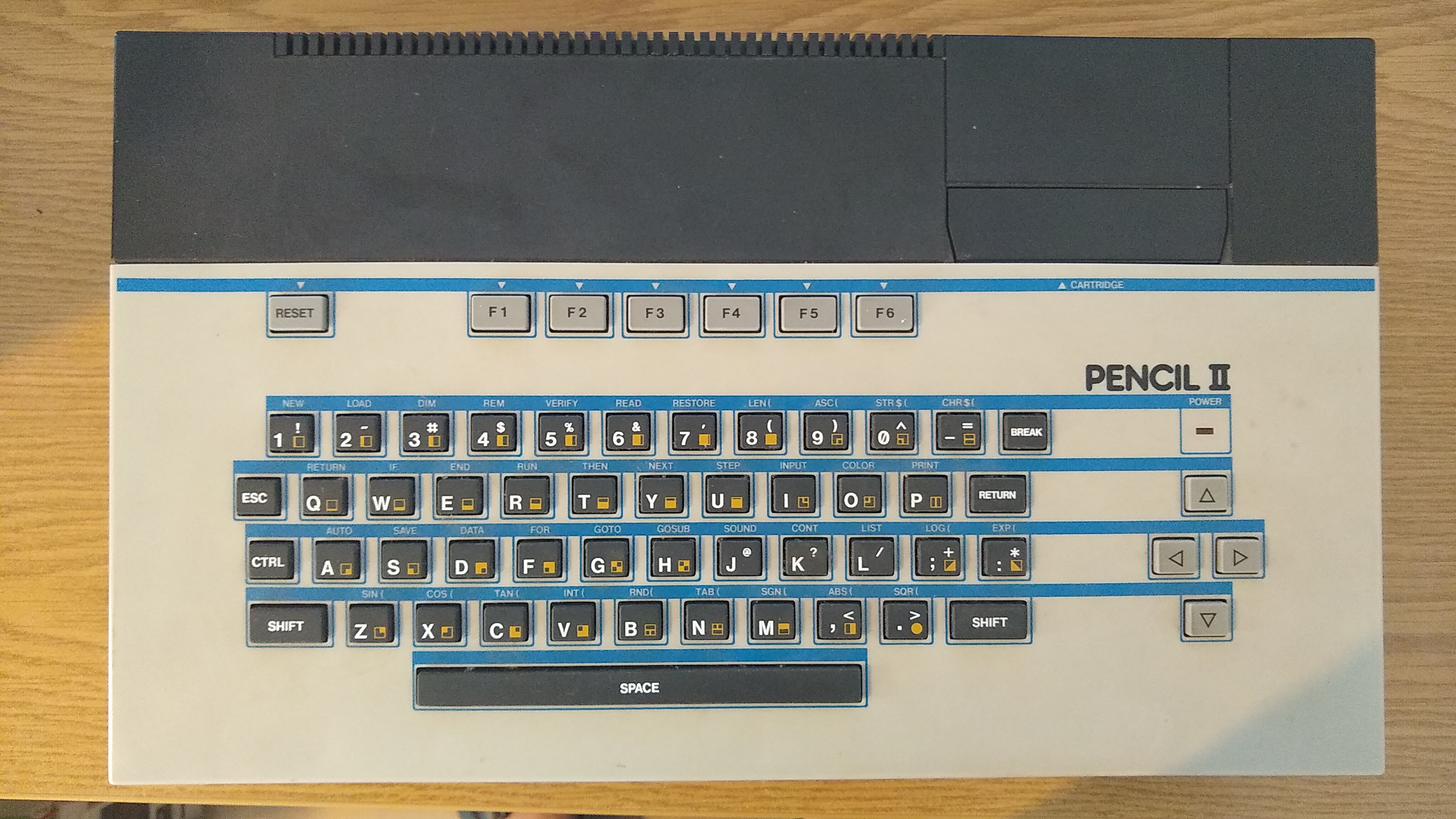
Somewhere in Hong Kong around 1983, a budget electronics company called Soundic Electronics — better known for cranking out Pong clones — decided to build a home computer. They took the exact same chips that powered the ColecoVision game console, added a rubber keyboard, doubled the RAM to a whopping 2 KB, and called it the Pencil II. There was never a Pencil I.
The machine was exported to Australia under the Hanimex brand (short for Jack Hannes Import and Export) and briefly appeared in France and the UK. It was crushed almost immediately by the Commodore 64 and vanished within months. Most units were returned under warranty because the cartridge slot kept coming loose.
Today, the Hanimex Pencil II is one of the rarest Z80 computers in existence. Only three game cartridges were made for it, though a surprisingly complete cassette software library of 27 programs was also released. But what makes it fascinating for ColecoVision collectors is what’s hiding under the hood — it’s a ColecoVision with a keyboard bolted on.
3
Original Cartridges
4
Homebrew Games
27
Cassette Programs
1983
Year Released
THE MYSTERY OF THE COLECOVISION ADAPTER
If the Pencil II is really a ColecoVision under the skin, why can’t it just play ColecoVision cartridges? The answer is the BIOS. When a ColecoVision boots, it looks for the magic bytes $55/$AA at the start of the cartridge. When a Pencil II boots, it looks for the string “COPYRIGHT SOUNDIC”. A ColecoVision cartridge doesn’t have that string, so the Pencil II rejects it.
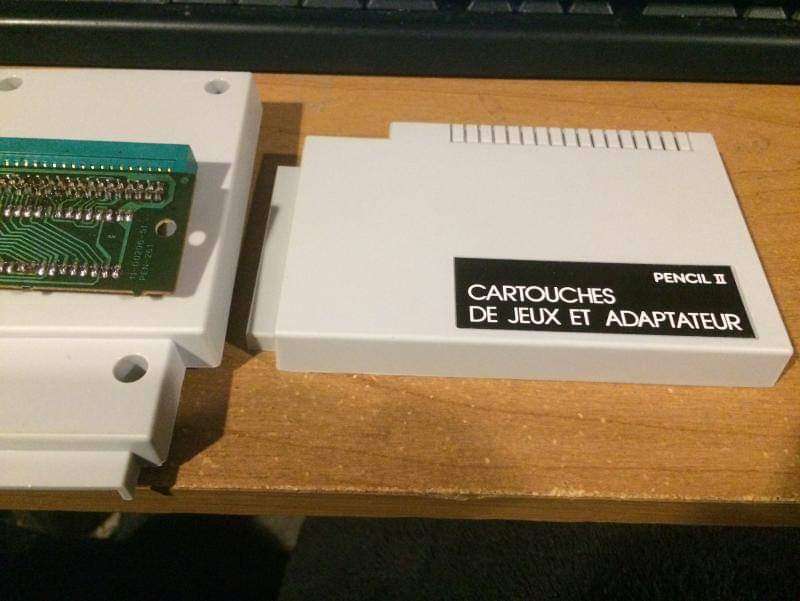
Soundic’s solution was brilliantly simple: a plug-in adapter module. A white plastic cartridge labeled “CARTOUCHES DE JEUX ET ADAPTATEUR” that slid into the side expansion slot.
The adapter — French market unit. Plugs into the side expansion slot.
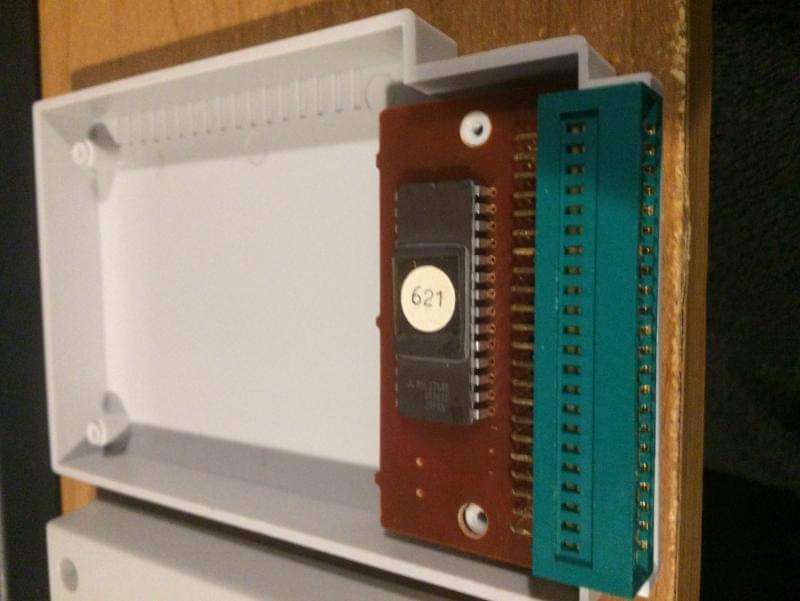
Inside: one chip. A single 8 KB EPROM labeled “621” — that’s it. No glue logic, no decoders.
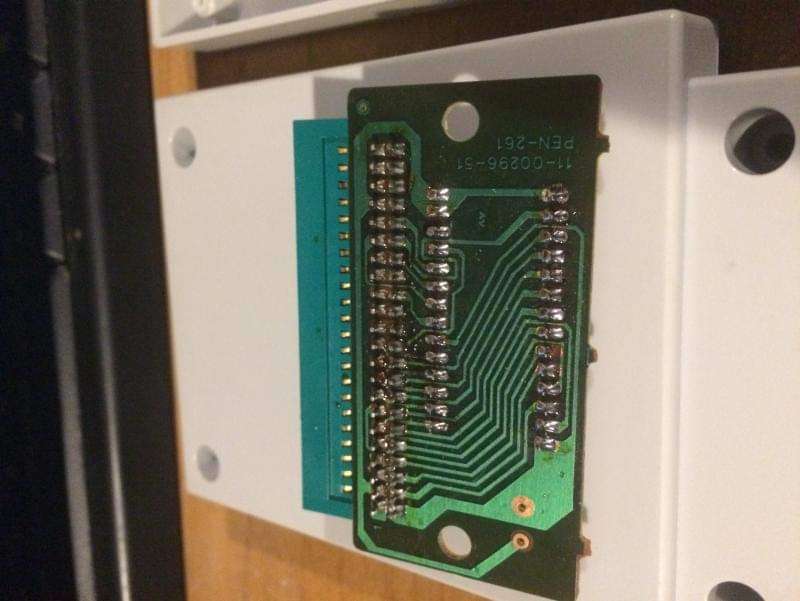
PCB: PEN-261 / 11-00296-S1. Traces route the EPROM directly to the expansion slot.
When you open the adapter, you find a single EPROM chip and nothing else. That chip contains a ColecoVision-compatible BIOS. When plugged in, it overrides the Pencil II’s own BIOS by pulling a disable signal high on the internal ROM. The Pencil II’s main cartridge slot is physically identical to the ColecoVision’s, so CV game cartridges slide right in.
“With the Coleco BIOS, all games that I’ve tried work as if they were in a ColecoVision… Well they are PAL and slow, but they work.”
— plgDavid (silicium.org), after testing 20+ ColecoVision cartridges on his modified Pencil II, April 2019
The adapter’s BIOS has never been dumped. It remains one of the last undumped ROMs in the ColecoVision ecosystem. The adapter itself is the “holy grail” of Pencil II collecting — far rarer than the already-rare computer itself.
INSIDE THE MACHINE
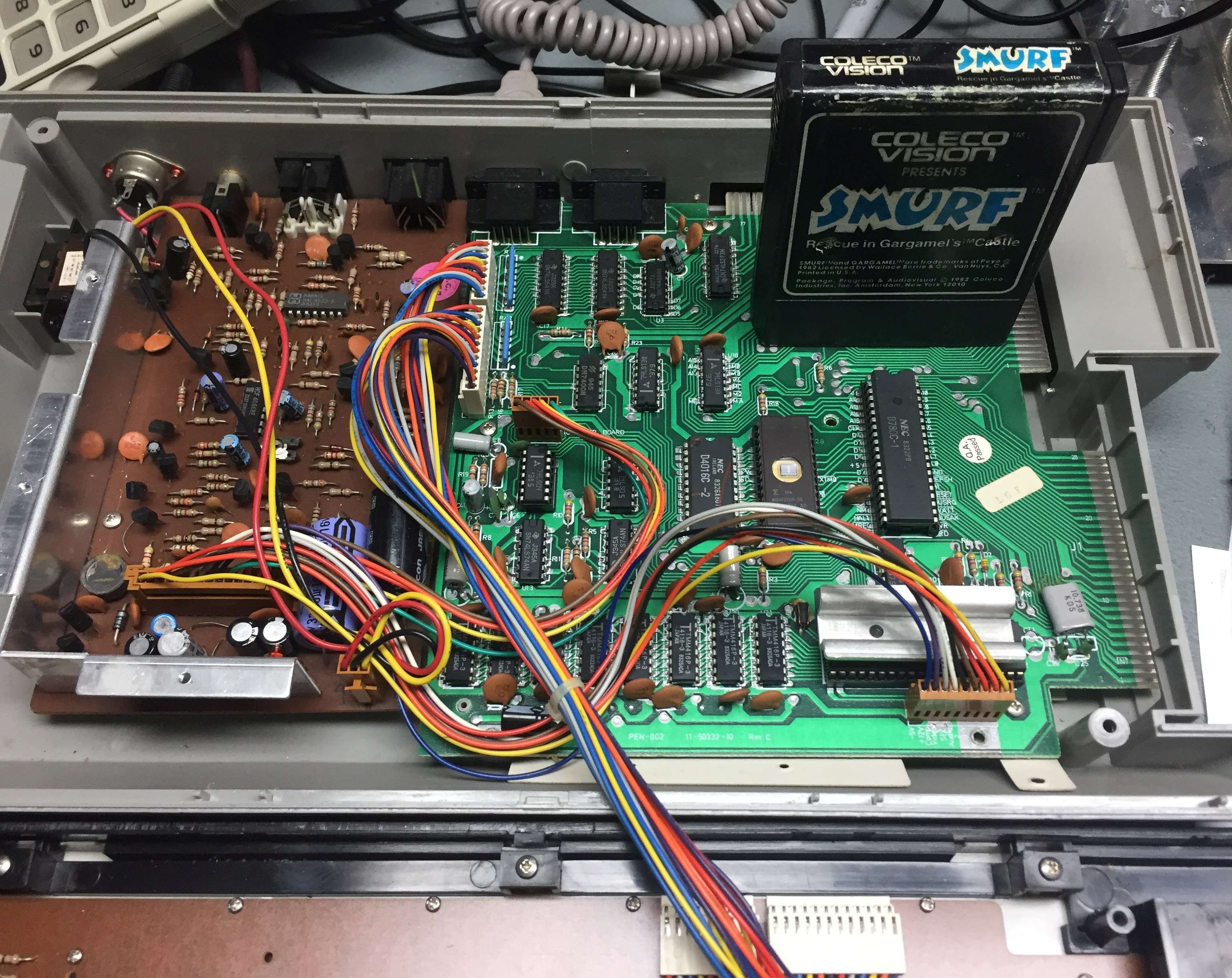
Open up a Pencil II and you’ll find the same chipset that powers a ColecoVision — chip for chip, pin for pin. The CPU is a NEC D780C-1 (a Z80A clone) running at 3.58 MHz. The video chip is a TI TMS9929 (the PAL variant of the ColecoVision’s TMS9918). The sound chip is a TI SN76489A. There’s 16 KB of VRAM. Even the I/O ports are mapped to the same addresses.
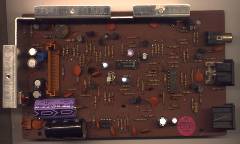
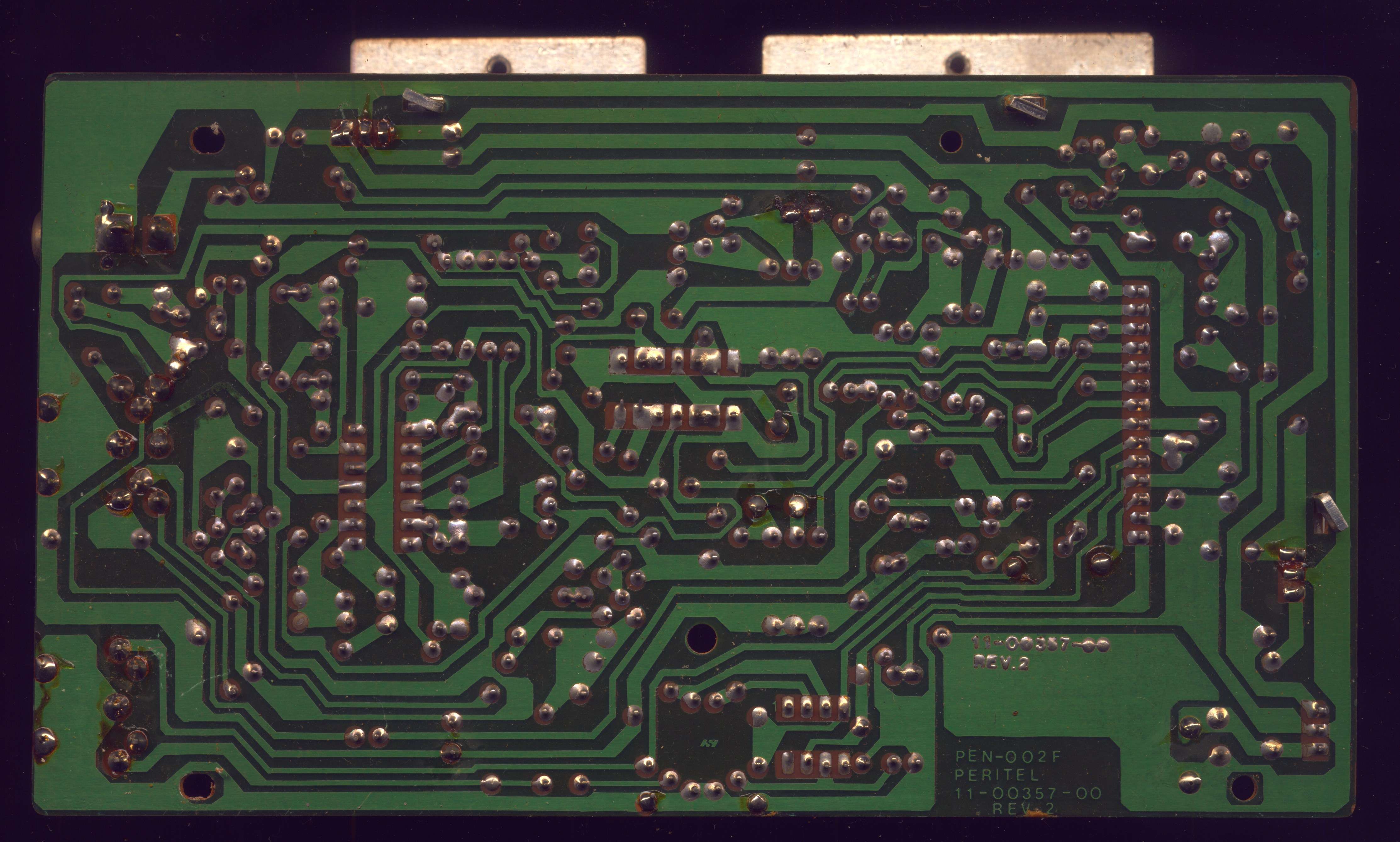
The photo here shows plgDavid’s Pencil II with a ColecoVision “Smurf: Rescue in Gargamel’s Castle” cartridge plugged directly into the main slot — running perfectly after a BIOS switch modification. The green CPU board (marked PEN-BG2) and the brown power/SCART board are clearly visible, connected by ribbon cables.
What Soundic added beyond the ColecoVision: a rubber chiclet keyboard (ZX Spectrum style), a cassette interface, a printer port, and an expansion slot for RAM packs (16 KB and 64 KB). They also doubled the system RAM from 1 KB to 2 KB — which turned out to cause no compatibility issues with ColecoVision games whatsoever.
Key Specifications
CPU
NEC D780C-1 (Z80A clone) @ 3.58 MHz
Video
TI TMS9929 (PAL) — 256×192, 16 colors, 32 sprites
Sound
TI SN76489A — 3 tone + 1 noise channel
RAM / VRAM
2 KB system RAM (expandable to 80 KB) / 16 KB VRAM
SD-BASIC v1.0/v2.0 on 12 KB ROM cartridge (separate purchase)
Dimensions
37 × 22 × 7.5 cm / 1.5 kg
Pencil II vs ColecoVision: Spot the Difference
Feature
ColecoVision
Pencil II
CPU
Z80A @ 3.58 MHz
NEC D780C-1 (Z80A) @ 3.58 MHz
VDP
TMS9918A (NTSC) / TMS9929 (PAL)
TMS9929 (PAL)
Sound
SN76489AN
SN76489A
RAM
1 KB
2 KB (expandable)
VRAM
16 KB
16 KB
Keyboard
No
✔ Chiclet rubber
BASIC
No (ADAM needed)
✔ SD-BASIC cartridge
Cassette
No (ADAM needed)
✔ Built-in
Cart Slot Pinout
Identical 30-pin
Memory Map
Identical (confirmed by trace)
I/O Ports
Identical ($BE/$BF, $E0/$E2, $FF)
SOFTWARE LIBRARY — MORE THAN MEETS THE EYE
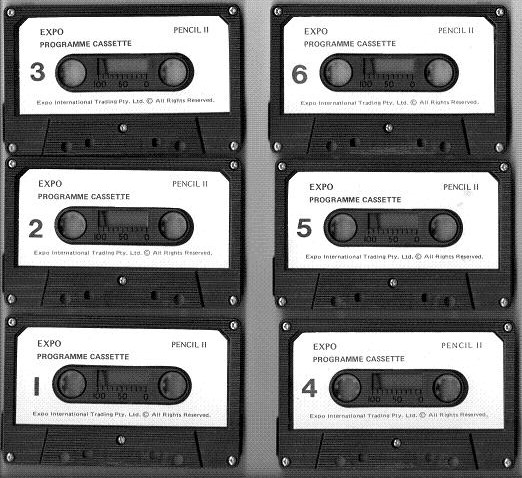
The Pencil II is often described as having “only two or three games,” but the reality is more interesting. While only three cartridges were released, the system also had a surprisingly robust cassette software library of 27 programs across 6 tapes, published by Expo in 1984. All known software has now been dumped and preserved in MAME.
Game Cartridges (3)
PEN-701: Le Jardin Magique / Big Foot Chase — Dumped January 2026. The mystery is solved: “Big Foot Chase” (seen at the Canadian PC Museum) and “Le Jardin Magique” (The Magic Garden) are the same game, renamed for different markets.
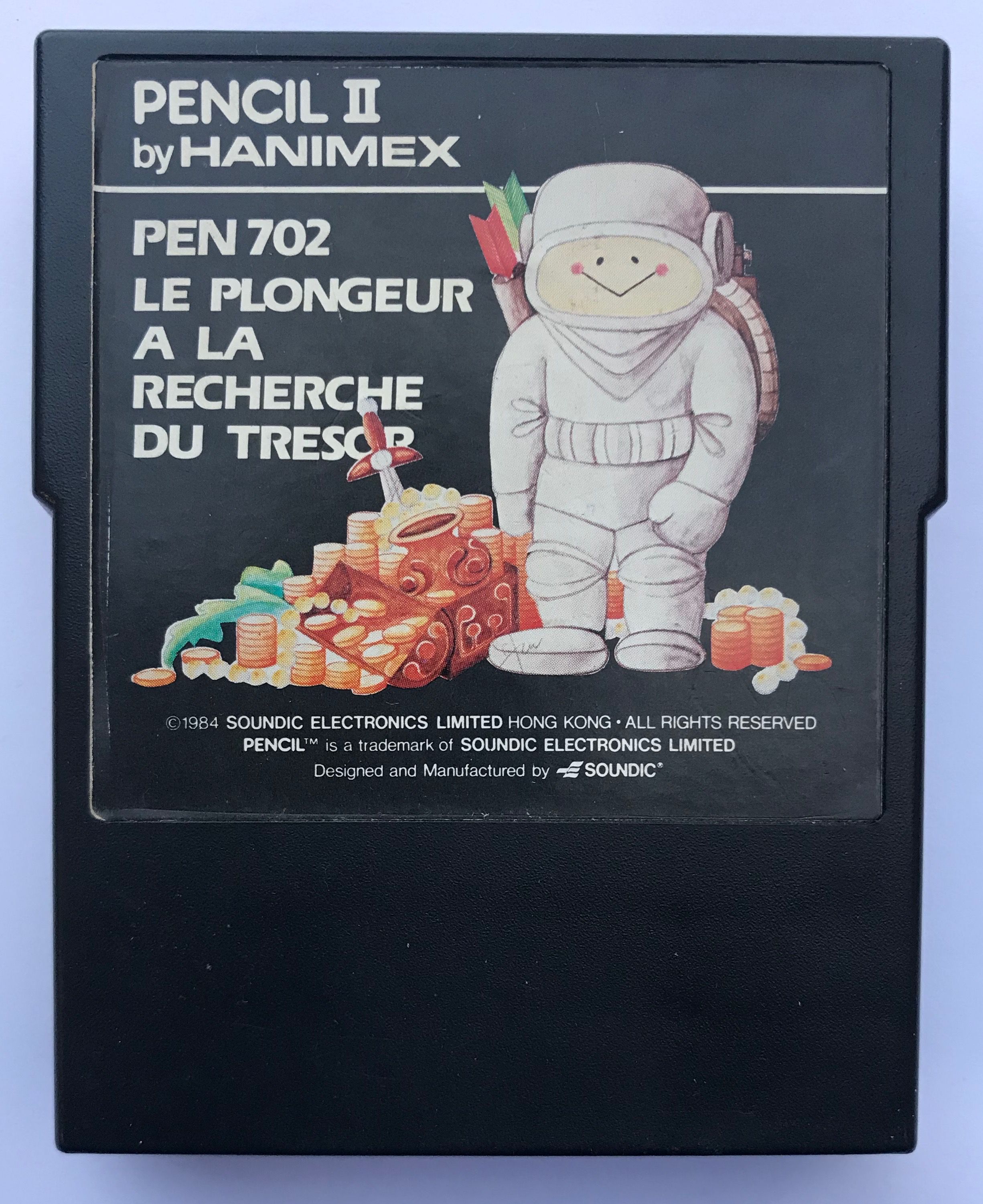
PEN-702: Le Plongeur à la Recherche du Trésor (Treasure Hunt) — Dumped May 2019 by Silicium.org. The first Pencil II game ever preserved.
PEN-700: SD-BASIC v2.0 — The programming cartridge. Versions 1.0 (Soundic) and 2.0 (Hanimex) exist.
Published by Expo, this cassette collection reveals the Pencil II was marketed as a genuine home computer, not just a game machine. The library spans games, education, music, and business applications — all requiring the SD-BASIC cartridge and a cassette recorder to load.
Tape 1 — Getting Started
INSTRUCT — System instruction/tutorial
TEST — System test program
EDPRAC — Education practice
Tape 2 — Math & Music
MATHVADR — Math Invaders (educational game)
MATHTASK — Math tasks/drills
MUSIC — Music composition program
MOOG — Synthesizer/sound program
Tape 3 — Numbers & Logic
NUMWORD — Number-to-word conversion
NUMSIZE — Number sizing exercise
PENMIND — Mastermind-style logic game
CALENDAR — Calendar utility
Tape 4 — Education
SPELLER — Spelling practice
GEOGRPHY — Geography quiz
HISTORY — History quiz
Tape 5 — Business & Productivity
CHEQUE — Cheque book manager
EXPENSES — Expense tracker
INVENTRY — Inventory management
LETTER — Letter writer/word processor
Tape 6 — Games
NAUGHTS — Noughts & Crosses (Tic-Tac-Toe)
BATLSHIP — Battleship
TANK — Tank combat game
LOGIC — Logic puzzle game
Each tape also includes an INFORM program (INFORM2 through INFORM6) providing loading instructions. The full MAME cassette software list documents all 27 programs.
Downloads — Cassette Tapes & Manual
The demo tapes were dumped by Robbbert (MAME developer). We are hosting the tape images and user manual for preservation:
With the CV adapter (or BIOS switch mod), the Pencil II gains access to the entire ColecoVision library of 125+ cartridges. plgDavid tested over 20 CV games with zero failures. The 2 KB vs 1 KB RAM difference caused no compatibility issues.
Homebrew — New Games Are Still Being Made
Perhaps the most remarkable chapter in the Pencil II’s story: developers are still creating new software for the platform, over 40 years after its release. The MAME cartridge software list now includes 4 homebrew titles alongside the 3 originals:
H-Tron (2019) — A Tron-style light cycle game, created during the 2019 Bannister forum revival
Deepspace (2022) — A space-themed game
Mastermind RK (2025) — The classic code-breaking logic game
Sokoban RK (2025) — The classic box-pushing puzzle game
New Software in 2019 — 36 Years After Release
xavierm (Xavier Messner) wrote new Z80 assembly programs for the Pencil II in 2019, including a Nyan Cat demo and VDP raster bar tests. His code is published at github.com/xmessner/pencil2 — the only modern development SDK for native Pencil II software. The machine is also emulated in MAME (driver: pencil2) and ColecoDS (Phoenix Edition).
PHOTO GALLERY
High-resolution photographs and PCB scans from plgDavid (silicium.org) and xavierm, April 2019. These images documented the Pencil II’s internals for the first time and enabled the reverse-engineering of the ColecoVision adapter mechanism.
The Box, Cartridges & Peripherals
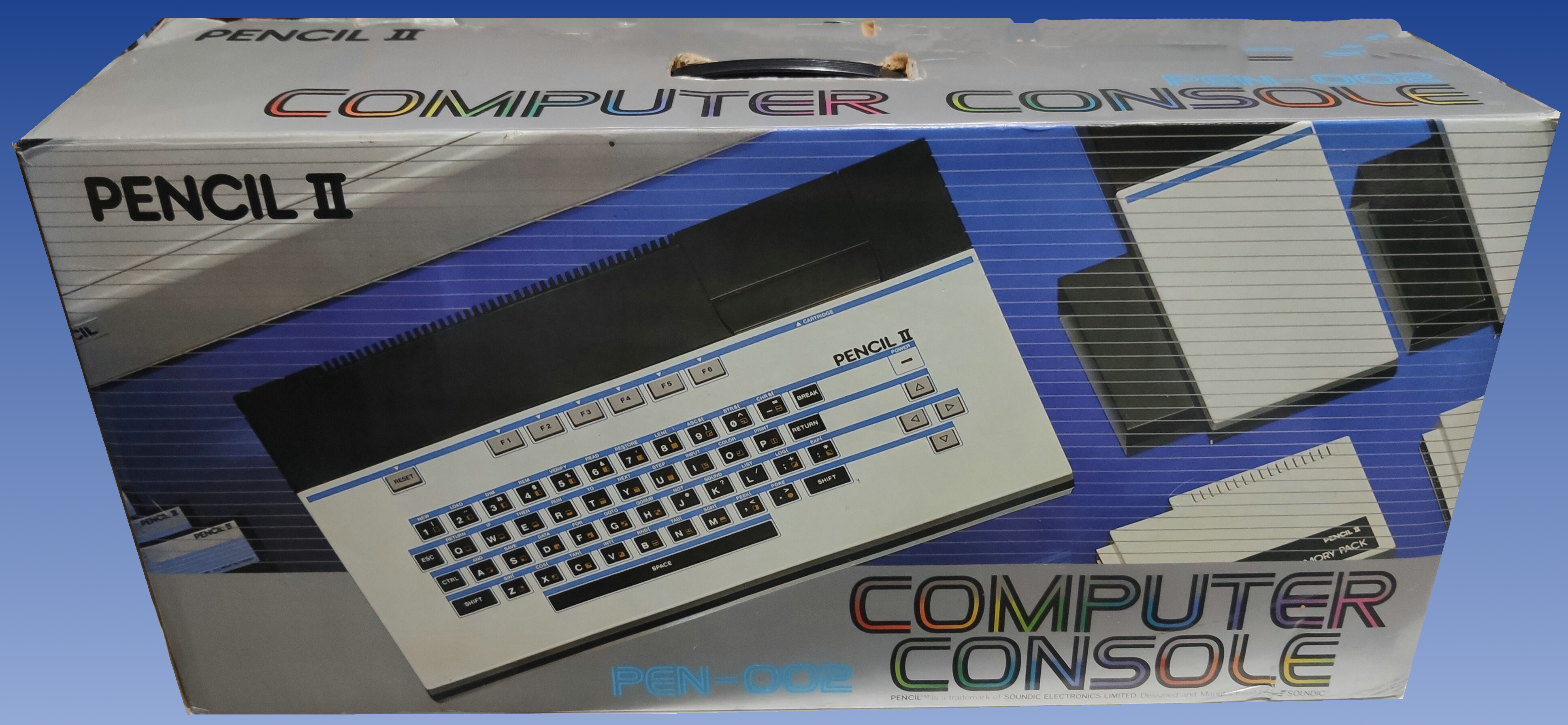
Retail Box: The Pencil II in its original packaging. Extremely rare to find boxed.
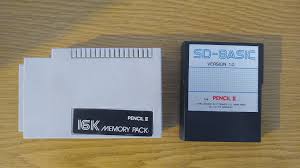
Memory Pack & SD-BASIC: The 16 KB RAM expansion and SD-BASIC cartridge — essential accessories for using the Pencil II as a computer.
Game Cartridge: PEN-702 “Le Plongeur à la Recherche du Trésor” (Treasure Hunt) — one of only two original game cartridges. Dumped May 2019.
Expo Cassette Software
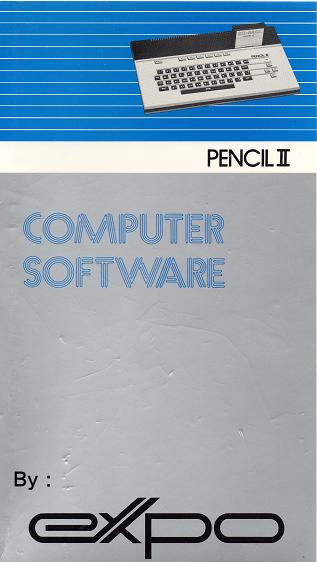
Expo Software Cover: The “Computer Software by Expo” cassette library packaging. 27 programs across 6 tapes covering education, games, music, and business.
Demo Tapes: The 6 cassette tapes bundled with the Pencil II. All dumped by Robbbert (MAME developer) and available for download below.
Motherboard & Internals
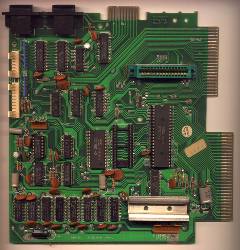
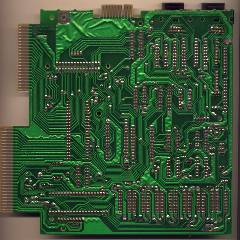
CPU Board (Top): PEN-BG2 11-50032-10 Rev C. The Z80A, TMS9929 VDP, and 74LS138 decoder are visible.
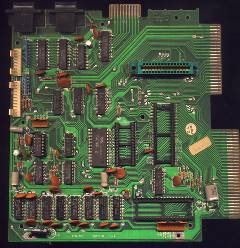
CPU Board (Bottom): plgDavid traced the 74LS138 from this side to map the complete memory architecture.
CPU Board (Solder Detail): Dense trace routing for the Z80, VDP, and memory decoder.
If you acquire a Pencil II, open it immediately and resolder every joint on the cartridge slot connector. This is the #1 failure point. Also dump the M5L2764 BIOS EPROM right away — these chips are prone to bitrot (plgDavid’s unit read half garbage). Tighten the two self-tapping screws on the slot socket firmly.
ABOUT SOUNDIC & HANIMEX
Soundic Electronics (Hong Kong)
Budget electronics manufacturer, 1970s–80s
Known for Pong-style consoles and handheld games
Products rebranded and sold under many names worldwide
The Pencil II was their only home computer — ever
Soundic-branded units carry a 1983 copyright date
Hanimex (Australia)
Full name: Jack Hannes Import and Export
Australian trading company, originally a camera/lens importer
Imported and rebranded Pong games from Asian manufacturers
Distributed the Pencil II in Australia and Europe from 1984
Traced directly from the Pencil II motherboard by plgDavid (April 2019). The memory decoding uses a single 74LS138 3-to-8 line decoder (U10) with inputs A=A15, B=A14, C=A13. The resulting map is functionally identical to the ColecoVision.
74138 Output
Address Range
Connected To
Function
Y0
$0000–$1FFF
BIOS EPROM + Memory slot pin 17
System BIOS (8 KB)
Y1
$8000–$9FFF
Cart pin 18
Cartridge ROM bank 1
Y2
$4000–$5FFF
Memory slot pin 18
External expansion
Y3
$C000–$DFFF
Cart pin 2
Cartridge ROM bank 3
Y4
$2000–$3FFF
Memory slot pin 16
External expansion
Y5
$A000–$BFFF
Cart pin 22
Cartridge ROM bank 2
Y6
$6000–$7FFF
RAM chip
System RAM (2 KB in 8 KB space)
Y7
$E000–$FFFF
Cart pin 27
Cartridge ROM bank 4
I/O Port Map
Port
Function
Direction
Notes
$BE
VDP Data Port (TMS9929)
Read/Write
VRAM data access
$BF
VDP Command/Status
R: Status / W: Register
Standard TMS99xx
$E0
Controller readback
Read
Joystick/keypad data
$E2
Controller scan
Write
Keypad scan select
$FF
Sound (SN76489A)
Write
PSG data write
BIOS ANALYSIS
Pencil II BIOS
8 KB M5L2764 EPROM
Checks for “COPYRIGHT SOUNDIC” at $8000–$8010
NMI vector: $0066 → jumps to $8014 (cart NMI handler)
Known BIOS call: $0505 = Turn off sound
Interrupt: NMI driven by TMS9929 VDP
ColecoVision BIOS
8 KB ROM
Checks for $AA/$55 at $8000–$8001
$AA/$55: Title screen with 12-second countdown
$55/$AA: Skip title, jump to code
Extensive BIOS API for VDP, sound, controllers
Native Pencil II Cartridge Header
; Pencil II cartridge header (disassembled by xavierm, 2019)org$8000defb"COPYRIGHT SOUNDIC"; $8000-$8010 — Required ID stringjp start ; $8011 — Program entry pointjp nmi_handler ; $8014 — NMI entry point
...
reti; $8029 — INT returndefb"VERSION!TITLE!DATE"; $8035+ — Metadata
CV ADAPTER — HOW IT WORKS
The adapter’s 2764 EPROM has its !OE (output enable) connected to expansion slot pin 17 — the Y0 output from the 74LS138 — mapping it to $0000–$1FFF.
The internal BIOS EPROM’s !OE line is labeled !XTM0 on the PCB silkscreen, pulled down through R6, and connects to expansion slot pin 2. Inside the adapter, pin 2 is tied to VCC (+5V), which pulls !XTM0 HIGH and disables the internal BIOS. No bus contention, no conflict — the adapter’s EPROM cleanly takes over at $0000.
starlord (AtariAge) — Community coordination, announced PEN-701 dump
ColecoVision™ is a trademark of its respective owner. Hanimex™ and Pencil II™ are trademarks of their respective owners. Historical information compiled from multiple public sources for preservation and educational purposes.