The Dual ColecoVision™ & Sega SG-1000 Clone Console
SYSTEM OVERVIEW
The DINA 2-in-1, originally known in Taiwan as the 創造者 50 (Chuang Zao Zhe 50, translating to “Creators’ Invent 50”), is a third-generation home video game console manufactured by Bit Corporation of Taiwan. It holds the unique distinction of being a dual-compatible clone console capable of playing both ColecoVision and Sega SG-1000 game cartridges — a feat made possible because both systems share nearly identical hardware architecture (same CPU, VDP, and sound chip).
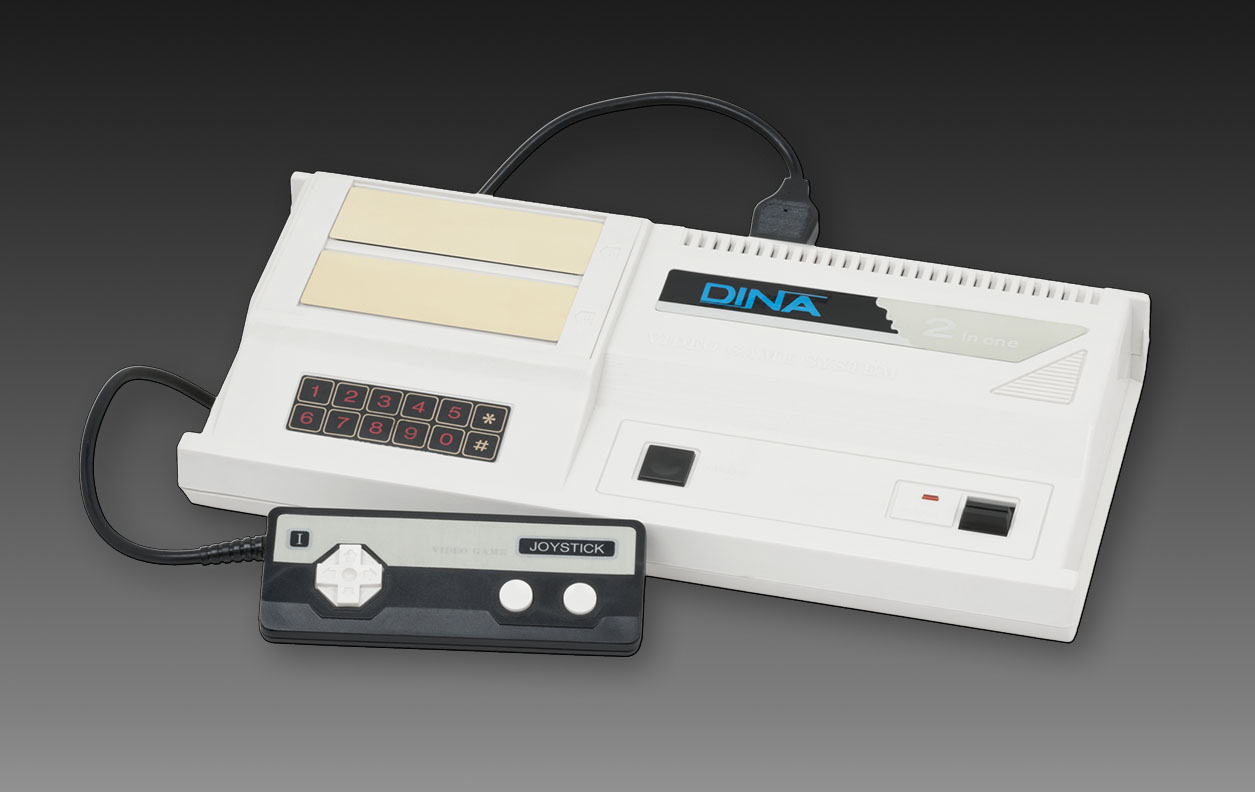
The console features two separate cartridge slots (one for each platform), NES-style D-pad controllers, a built-in numeric keypad on the console itself, and the game Meteoric Shower built into the system ROM. The DINA’s design is heavily inspired by the Sega SG-1000 Mark II, with compact slide-in controllers that store in the sides of the unit.
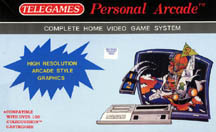
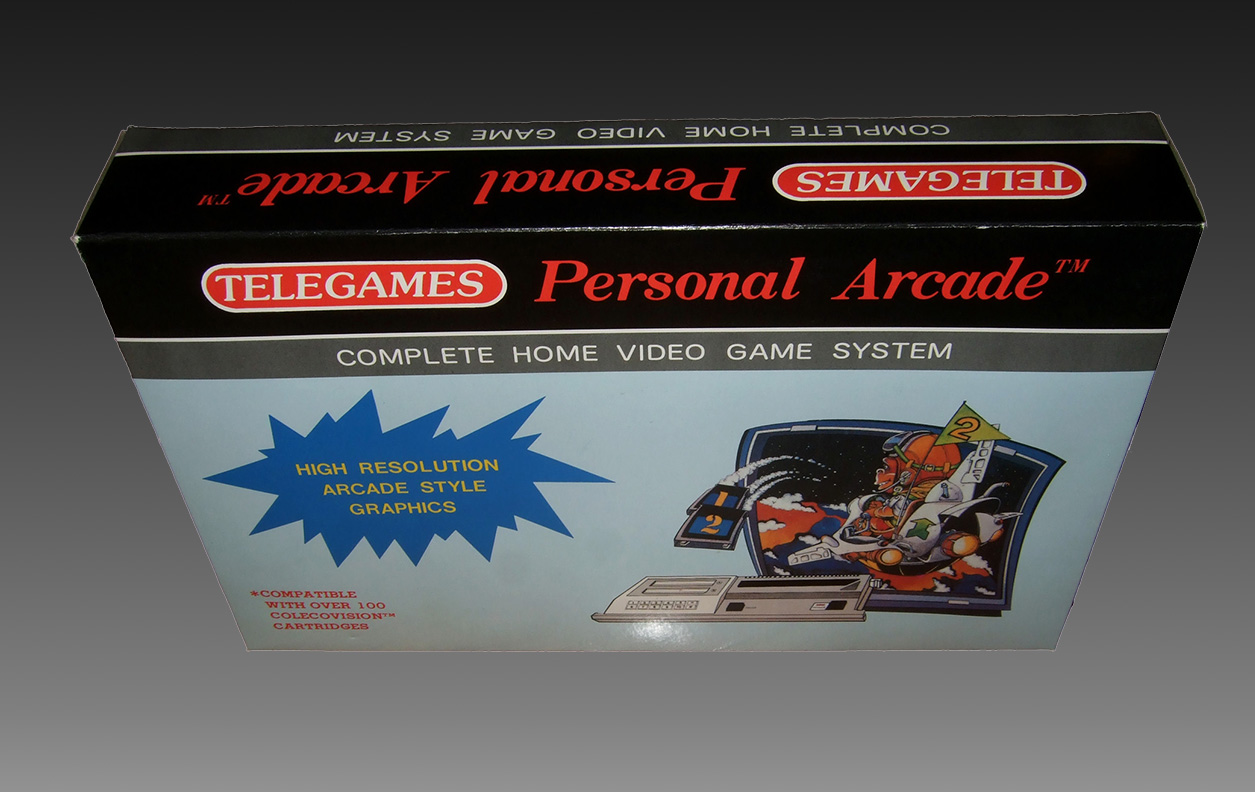
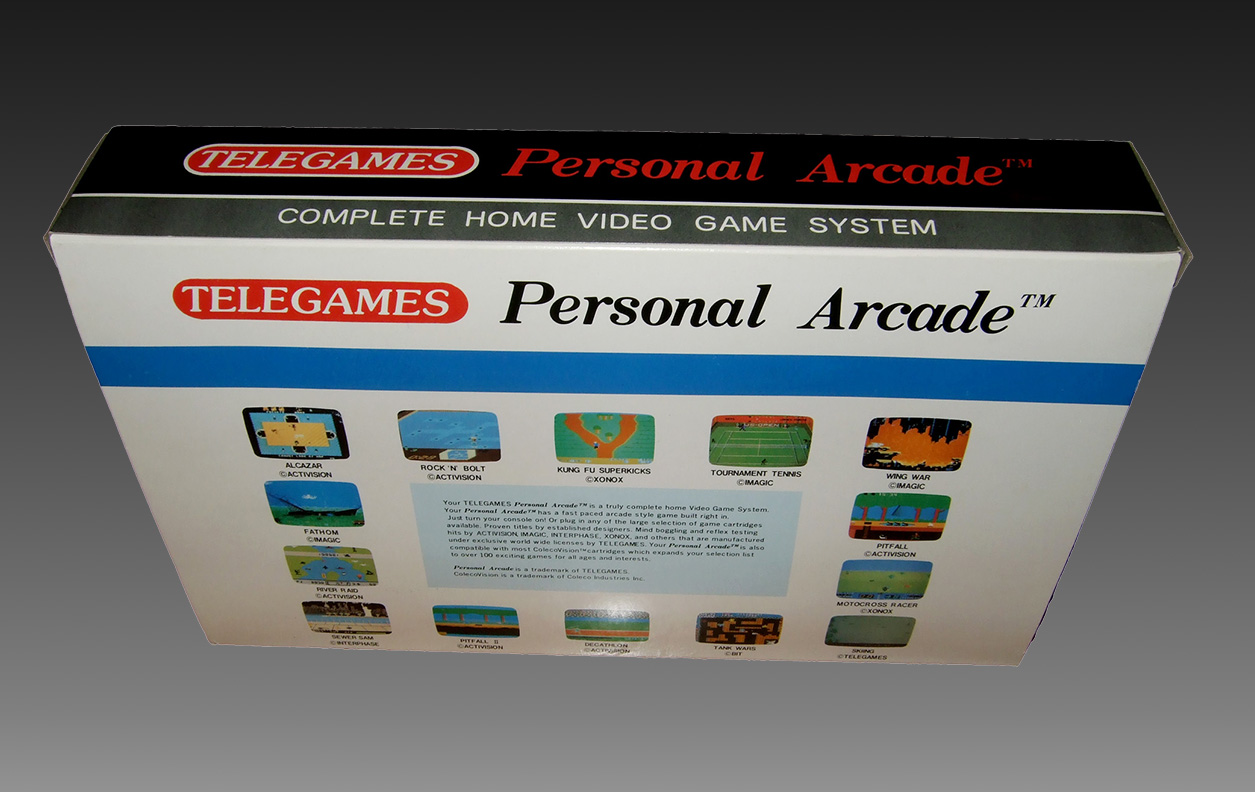
First released in Taiwan in 1986, the DINA was later brought to the North American market in 1988 by Telegames USA under the name Telegames Personal Arcade. Notably, Telegames never advertised the system’s SG-1000 compatibility, leaving the second cartridge slot unexplained to American consumers — since the SG-1000 was never officially released in the United States.
Today, both the DINA and the Telegames Personal Arcade are extremely rare collector’s items, owing to limited production runs, mail-order-only distribution in the US, and the infamous 1994 tornado that destroyed Telegames’ remaining stock.
🎮
Dual Compatibility
Plays both ColecoVision and Sega SG-1000 cartridges with separate cartridge slots for each platform.
🕹️
NES-Style Controllers
Compact D-pad controllers modeled after the NES gamepad. Slide into console sides for storage.
🔢
Console-Mounted Keypad
Single numeric keypad built into the front of the console for ColecoVision game input.
💰
Budget Price
Sold for just $40 USD via mail order in the US — significantly cheaper than the original ColecoVision.
📦
Built-In Game
Meteoric Shower built into the system ROM. Boots automatically when no cartridge is inserted.
⏸️
Pause Button
Front-mounted pause button works with SG-1000 games. Does not function with ColecoVision titles.
TECHNICAL SPECIFICATIONS
The DINA shares its core hardware architecture with both the ColecoVision and the Sega SG-1000, as all three systems use the same Z80 CPU, TMS9918-family VDP, and SN76489 sound chip. This hardware commonality is what makes dual compatibility possible.
Manufacturer
Bit Corporation (Taiwan)
Also Known As
Chuang Zao Zhe 50 (創造者 50) in Taiwan; Telegames Personal Arcade in USA
Internal leaf switch in SG-1000 slot auto-detects which slot is active
Built-In Game
Meteoric Shower (ColecoVision format)
Boot Screen
Green background with Japanese text and “1986 BIT CORPORATION” (replaces ColecoVision rainbow boot screen for Coleco titles)
Video Output
RF output (NTSC), tuned to Channel 13
Controller Ports
2 (Sega SG-1000 pinout — NOT ColecoVision pinout)
Power Supply
External +12V at 300mA DC adapter (NOT included with Telegames version)
Dimensions
Approx. 12″ × 5″ × 1″ (30cm × 13cm × 2.5cm)
Weight
Lightweight — much lighter than original ColecoVision or SG-1000
Construction
Low-cost injection-molded plastic
CONSOLE VARIANTS
The same hardware was sold under three different brand names across different markets. Internally, all versions are identical — only the branding, packaging, and marketing differed.
DINA 2-in-1 / Chuang Zao Zhe 50
Market: Taiwan & Asia (1986) Manufacturer: Bit Corporation Original Name: 創造者 50 (Chuang Zao Zhe 50) Openly marketed as playing both ColecoVision and Sega SG-1000 games. Having access to both game libraries contributed to the console’s relative success in Taiwan.
Telegames Personal Arcade
Market: United States (1988) Distributor: Telegames USA (Gun Barrel City, Texas) Price: $40 USD via mail order only Marketed only as a ColecoVision alternative. SG-1000 compatibility was never advertised since the SG-1000 was never sold in North America. For a period, only the box used Telegames branding — the console itself was still labeled DINA.
About Bit Corporation
Founded in 1982 in Taiwan, Bit Corporation started as an Atari 2600 game publisher and clone manufacturer. In 1984, they released the Bit 90, a ColecoVision-compatible home computer. With experience in ColecoVision hardware and knowledge that the Sega SG-1000 shared nearly identical internals, Bit Corporation created the DINA as a dual-compatible budget console to serve both the ColecoVision and SG-1000 markets simultaneously. Bit Corporation was also known globally as one of the largest producers of clone consoles and pirated game cartridges.
DESIGN & PHYSICAL LAYOUT
The DINA’s design is heavily inspired by the Sega SG-1000 Mark II. It is a slim, compact unit — significantly smaller and lighter than either the ColecoVision or the original SG-1000.
Front Panel
Numeric keypad (0–9, *, #) for ColecoVision games
Pause button (SG-1000 games only)
Power switch
Power indicator LED
Top / Cartridge Area
ColecoVision cartridge slot
Sega SG-1000 cartridge slot
Internal leaf switch for automatic slot detection
Rear Panel
2× controller ports (SG-1000 DB-9 pinout)
RF output jack (Channel 13, NTSC)
DC power input (12V 300mA)
Expansion port (not compatible with CV or SG-1000 add-ons)
Sides
Controller storage slots — gamepads slide into sides of console
Compact storage design keeps controllers secured to unit
Single Keypad Limitation
The DINA has only one numeric keypad mounted on the console. The original ColecoVision had keypads on both controllers, allowing two-player games to use them simultaneously. This single-keypad design means any ColecoVision game requiring two separate keypads (such as Fortune Builder’s two-player head-to-head mode) cannot be properly played. Additionally, the console-mounted keypad requires taking your hand off the controller to press keys — making keypad-intensive games significantly harder to play.
CONTROLLERS & INPUT
The DINA uses its own proprietary gamepads modeled after the NES controller form factor, with a D-pad on the left and two unlabeled action buttons on the right. These connect via the SG-1000 controller pinout (DB-9), which is critical to understanding compatibility.
Compatible Controllers
DINA / Personal Arcade included gamepads
Sega SG-1000 controllers
Sega Master System controllers
Other DB-9 controllers using SG-1000/SMS pinout
Incompatible Controllers
ColecoVision standard controllers (different pinout)
ColecoVision Super Action Controllers
ColecoVision Roller Controller
ColecoVision Driving Module / Steering Wheel
Critical Controller Difference
The DINA uses the Sega SG-1000 controller pinout, NOT the ColecoVision controller pinout. Despite both using DB-9 connectors, the wiring is different. This means no ColecoVision controllers of any kind can be used with the DINA. This is the single biggest source of game incompatibility — any ColecoVision game that requires the Super Action Controllers, Roller Controller, or Driving Module simply cannot be played.
The included DINA controllers are generally considered to be of poor quality with short, stiff cords. However, the SG-1000/SMS controller compatibility means you can use higher-quality Sega Master System controllers as replacements.
GAME COMPATIBILITY
ColecoVision Games
Vast majority of ColecoVision cartridges are compatible
Boot screen replaced with Bit Corporation splash (Coleco titles only)
Third-party opening screens are unaffected
Games requiring special controllers are incompatible
Keypad-intensive games are playable but more difficult
No Super Game Module (SGM) support
No Expansion Module support of any kind
Sega SG-1000 Games
Vast majority of SG-1000 ROM cartridges are compatible
Pause button works for SG-1000 titles
No Sega My Card slot (but Sega Card Catcher accessory works)
SK-1100 keyboard not compatible
SG-1000 expansion modules not compatible
Sega Card Catcher Compatibility
While the DINA does not have a native Sega My Card slot, the “Sega Card Catcher” peripheral (which converts a My Card into a standard cartridge form factor) is compatible and allows Sega My Card games to be played through the SG-1000 cartridge slot.
INCOMPATIBLE & DIFFICULT GAMES
ColecoVision Games — Incompatible (Will Not Work)
These games require special controllers or hardware the DINA cannot support:
✘Fortune Builder — requires 2 separate keypads (2-player head-to-head)
✘Front Line — requires Super Action Controller
✘Rocky Super Action Boxing — requires Super Action Controller
✘Super Action Baseball — requires Super Action Controller
✘Super Action Football — requires Super Action Controller
✘Super Action Soccer — requires Super Action Controller
✘Super Cobra — 2nd button (“bomb”) doesn’t work
✘Turbo — requires Driving Module (Steering Wheel)
✘Slither — requires Roller Controller
✘Victory — requires Roller Controller
ColecoVision Games — Playable But Difficult
These games work on the DINA but require quick keypad presses that are awkward with the console-mounted keypad:
⚠Aquattack — needs rapid keypad input
⚠Blockade Runner — needs rapid keypad input
⚠Mouse Trap — needs rapid keypad input
⚠Spy Hunter — needs rapid keypad input
⚠War Games — needs rapid keypad input
COLECOVISION vs. DINA 2-IN-1 COMPARISON
Feature
ColecoVision (1982)
DINA 2-in-1 (1986)
Sega SG-1000 (1983)
CPU
Z80A @ 3.58 MHz
Z80A @ 3.58 MHz
Z80A @ 3.58 MHz
VDP
TMS9928A
TMS9918A-family
TMS9918A
Sound
SN76489
SN76489
SN76489
RAM
1 KB
1 KB
1 KB
VRAM
16 KB
16 KB
16 KB
CV Games
✔ Full
⚠ Most (no special controllers)
✘ No
SG-1000 Games
✘ No
✔ Yes
✔ Full
Expansion Port
✔ ColecoVision modules
✘ Incompatible with all
✔ SG-1000 peripherals
Controller Pinout
ColecoVision DB-9
Sega SG-1000 DB-9
Sega SG-1000 DB-9
Keypad
On both controllers
Single, console-mounted
N/A
Video Output
RF (Ch. 2–4)
RF (Ch. 13)
RF
Pause Button
No
SG-1000 games only
No (SG-1000 II: Yes)
Built-In Game
No
Meteoric Shower
No
Original Price
$175 USD (1982)
$40 USD (1988 mail order)
¥15,000 (1983 Japan only)
KNOWN ISSUES & HARDWARE QUIRKS
The DINA was built to a very low price point, and its cost-cutting measures resulted in several well-documented hardware issues:
⚠VDP Overheating: The TMS9918-family VDP requires a heat sink, but the DINA omits this component to save cost. The VDP is prone to overheating during extended play sessions, which can cause display glitches or damage the motherboard over time. This is the most commonly reported hardware failure.
⚠RF Interference: The RF output is very prone to interference and produces a noticeably poorer picture quality than the original ColecoVision. The signal is tuned to Channel 13 (North American ColecoVision uses Ch. 2–4), which can be problematic. An AV composite mod can remedy this significantly.
⚠Poor Controller Quality: The included gamepads have short, stiff cords and generally poor build quality. Replacing them with Sega Master System controllers is a common collector recommendation.
⚠Low-Quality Construction: The console itself is built from cheap, lightweight plastic. It feels significantly less substantial than the original ColecoVision or SG-1000.
⚠No Dual-Cart Switch: There is no manual switch to select between the ColecoVision and SG-1000 cartridge slots. A small leaf switch inside the SG-1000 slot automatically detects which slot is in use. Do not insert cartridges into both slots simultaneously.
ℹPower Supply Not Included (Telegames version): To keep the $40 price point, the Telegames Personal Arcade did not include a power supply, RF switch box, or instructions. Buyers had to source a 12V 300mA DC adapter separately.
HISTORY & TIMELINE
1982
Bit Corporation founded in Taiwan. Begins publishing Atari 2600 games and producing Atari 2600 clone hardware.
1982
ColecoVision released in North America by Coleco Industries at $175 USD.
July 1983
Sega releases the SG-1000 in Japan, sharing nearly identical hardware to the ColecoVision (same CPU, VDP, and sound chip).
1983–1984
The North American video game crash devastates the console market. ColecoVision sales decline sharply.
1984
Bit Corporation releases the Bit 90 home computer, a ColecoVision-compatible system with a built-in keyboard and BASIC programming language.
1985
Coleco discontinues the ColecoVision. The console can still be found at retail for reduced prices.
1986
Bit Corporation releases the DINA 2-in-1 (Chuang Zao Zhe 50) in Taiwan. The dual ColecoVision/SG-1000 compatibility and low price point drive moderate success in the Taiwanese market. Meteoric Shower is built into the console ROM.
1988
Telegames USA, having acquired ColecoVision rights and remaining Coleco stock, approaches Bit Corporation to rebrand the DINA for the US market. The Telegames Personal Arcade launches at $40 via mail-order catalog from Gun Barrel City, Texas. SG-1000 compatibility is kept secret.
Late 1980s
The DINA/Personal Arcade struggles to gain traction. The Nintendo Entertainment System dominates the market. Used ColecoVisions are cheaper and more capable. Limited advertising and mail-order-only distribution suppress sales.
April 1994
A tornado strikes Telegames’ storage facility, destroying their remaining stock of Personal Arcade consoles. This event makes surviving units extremely rare.
1996
Telegames releases a ColecoVision game compilation for Windows titled “Telegames Personal Arcade” — reusing the brand name for a software product.
Present
The DINA 2-in-1 and Telegames Personal Arcade are highly sought-after collector’s items. Boxed examples command premium prices on the secondary market.
THE TELEGAMES STORY
Telegames was a Britain-based video game company that operated a US subsidiary, Telegames USA, headquartered in the memorably named Gun Barrel City, Texas. After the video game crash of 1983 devastated Coleco, Telegames purchased the rights to the ColecoVision console and acquired most of Coleco’s remaining stock.
Rather than attempting to sell the bulky, aging ColecoVision hardware, Telegames made the shrewd decision to source the cheaper, more compact DINA 2-in-1 from Bit Corporation. Rebranded as the Telegames Personal Arcade, the system was marketed exclusively through Telegames’ mail-order catalog at an aggressive $40 price point — making it one of the cheapest consoles available in the late 1980s.
However, several factors undermined the Personal Arcade’s commercial success. The system was available only by mail order with virtually no retail presence or advertising. The ColecoVision was already discontinued and could be found used for less than $40. The box omitted the power supply, RF switch box, and instructions to hit the price point. And the NES had already captured the market with a vastly more capable system.
Perhaps the most curious decision was Telegames’ choice to hide the SG-1000 compatibility — the console’s most unique feature. Since the SG-1000 was never sold in North America, Telegames apparently decided the feature was unmarketable. The second cartridge slot was never explained in any advertising, leaving consumers puzzled about its purpose. Ironically, it wasn’t until years later that collectors realized these machines could play Sega games.
During a period of the rebranding, only the box carried the Telegames name — the console unit itself was still labeled “DINA 2 in one.” It is unknown whether Sega was ever aware the Telegames Personal Arcade existed, as its small-scale, mail-order distribution may have flown entirely under the radar.
COLLECTING & RARITY
Both the DINA 2-in-1 and the Telegames Personal Arcade are considered rare collectibles in the retro gaming community. Several factors contribute to their scarcity:
Why They’re Rare
Limited production runs from a small Taiwanese manufacturer
Telegames sold exclusively via mail order — no retail distribution
Minimal advertising meant low public awareness and sales
Boxed examples are extremely scarce and command premium prices
Some units have Telegames box but DINA-labeled console
Working units should be tested for VDP overheating issues
Original power supply is rarely included — source a 12V 300mA adapter
Original controllers often have deteriorated cables
AV composite mod greatly improves the poor RF video quality
Meteoric Shower Cartridge
The built-in game Meteoric Shower also exists as a standalone cartridge (production number PG 903) from 1983, compatible with both the Bit 90 computer and the ColecoVision. The standalone cartridge is considered extremely rare in its own right.
FREQUENTLY ASKED QUESTIONS
Are the DINA and Telegames Personal Arcade the same console?
Yes — they are the same hardware manufactured by Bit Corporation. The DINA / Chuang Zao Zhe 50 was the original Asian market release (1986), while the Telegames Personal Arcade was a rebranded version sold in the US (1988). The only differences are the box branding and marketing. During the transition period, some consoles shipped in Telegames boxes but still had “DINA 2 in one” printed on the console itself.
Can I use my ColecoVision controllers with the DINA?
No. Despite using the same DB-9 connector shape, the DINA uses the Sega SG-1000 controller pinout, which is wired differently from the ColecoVision pinout. ColecoVision controllers, Super Action Controllers, Roller Controllers, and Driving Modules are all incompatible. You can use Sega SG-1000 or Master System controllers as alternatives.
What is the second cartridge slot for?
The DINA has two cartridge slots — one for ColecoVision games and one for Sega SG-1000 games. On the Telegames Personal Arcade, the SG-1000 slot was never explained in advertising since the SG-1000 was not sold in North America. Despite this, it is fully functional for playing SG-1000 cartridges.
Why does the boot screen look different from my ColecoVision?
The DINA replaces the famous ColecoVision rainbow boot screen with its own splash screen: a green background with Japanese text and “1986 BIT CORPORATION.” This only affects Coleco-published titles. Third-party game publisher splash screens appear normally.
Can I connect ColecoVision expansion modules?
No. The DINA has a rear expansion port, but it is not compatible with any ColecoVision or SG-1000 expansion hardware. Expansion Module #1 (Atari adapter), Expansion Module #3 (ADAM computer), the Super Game Module, and SG-1000 peripherals like the SK-1100 keyboard will not work. However, there are rumors that the Atari converter may partially function.
Can I play Sega My Card games?
The DINA does not have a native My Card slot. However, the “Sega Card Catcher” peripheral (which adapts a My Card to a standard cartridge form factor) is compatible with the DINA’s SG-1000 cartridge slot, allowing My Card games to be played through it.
Does the DINA work on PAL TVs?
The DINA’s RF output is NTSC. There are reports that it may work on both PAL and NTSC television systems, but performance on PAL sets is not guaranteed. An AV composite mod bypasses the poor RF output and may improve compatibility with modern displays.
Why is the RF output on Channel 13?
North American ColecoVision consoles output RF on channels 2–4, but the DINA is tuned to Channel 13. This is likely because the console was originally designed for the Taiwanese market. This can cause issues if your TV or RF switch expects a channel 2–4 signal. Performing an AV composite video modification is the recommended solution.
How much is a DINA / Personal Arcade worth?
Values vary significantly based on condition and completeness. Loose working units can range from moderate to high collector prices. Boxed complete examples are extremely rare, especially Telegames-branded versions, and command premium prices. The 1994 tornado that destroyed Telegames’ remaining inventory makes complete-in-box examples particularly scarce.
What happened to Bit Corporation?
Bit Corporation was a Taiwanese company founded in 1982 that was widely known as one of the world’s largest producers of clone consoles and pirated game cartridges. They produced clones and games for Nintendo, Sega, Atari, and ColecoVision systems. In addition to the DINA, they also manufactured the Bit 90 (a ColecoVision-compatible home computer) and the Bit 60 (an Atari 2600 clone). The company eventually ceased operations, though the exact date is not well-documented.
ColecoVision™ is a trademark of its respective owner. Sega SG-1000™ is a trademark of Sega Corporation. Telegames Personal Arcade is a trademark of Telegames. All product names, trademarks, and registered trademarks are property of their respective owners. Historical information compiled from multiple public sources for preservation and educational purposes.



.jpg)